
Scenario
Your child is smart. They do well in school. They’re funny, creative, and full of life. But the moment you step into a gathering, visit a relative, or sit down at the dinner table, something shifts. The “please” and “thank you” disappear. Eye contact goes out the window. Greetings feel like pulling teeth.
Sound familiar?
You are not alone, and you are not failing as a parent.
Teaching children between the ages of 7 and 11 good manners is one of the most common challenges parents face today. This age group is old enough to understand expectations, yet wired to push back against them. But here is the good news: ages 7 to 11 is one of the most powerful windows for shaping a child’s character. The habits they form right now: how they greet people, how they speak to adults, how they treat friends are the habits that follow them into adulthood.
This guide will show you exactly how to teach kids manners in ways that stick, without turning every interaction into a battle of wills.
Table of Contents
TL;DR
Teaching children ages 7–11 good manners requires consistent modelling, age-appropriate reasoning, and identity-based praise. The 10 most important manners to focus on are: proper greetings, genuine gratitude, real apologies, active listening, respectful tone, table manners, respecting personal space, unprompted kindness, handling disagreement calmly, and appropriate screen use. This age window is critical because children are cognitively ready to understand why manners matter, not just that they should have them.
Why Ages 7–11 Is the Most Important Window for Teaching Manners
Before we get into the “how,” it helps to understand the “why” behind this particular age group.
Between ages 7 and 11, children are in what developmental psychologists call the concrete operational stage. During this phase, children can think logically, understand cause and effect, and begin to see things from another person’s perspective. This means they are cognitively ready for the first time to understand why manners matter, not just that they should have them.
Research in child development consistently shows that children who develop social and emotional skills during the primary school years are more likely to build healthy friendships, perform better academically, and grow into confident, considerate adults. Good manners are not separate from these outcomes, they are the visible expression of them.
What the research shows:
| Finding | Source |
Children who develop strong social-emotional skills in primary school are significantly more likely to build healthy adult relationships | CASEL — Collaborative for Academic, Social, and Emotional Learning |
Empathy meaningfully develops between ages 7–9, making this the ideal window for targeted teaching | Harvard Center on the Developing Child |
Children who feel respected at home are more likely to show respect to others in school settings | Journal of Child Development |
Key Takeaway: Ages 7–11 is the developmental sweet spot where children first become capable of understanding why manners matter, not just that they are expected to have them. This makes it the most important window for character formation.
What “Good Manners” Actually Means for This Age Group
Good manners are not just about saying “please” and “thank you.” At ages 7 to 11, good manners cover five distinct categories:
Category | What It Covers | Why It Matters |
Verbal manners | Greetings, gratitude, apologies, respectful disagreement | Foundation of all social communication |
| Physical manners | Personal space, table etiquette, not interrupting | Shows bodily awareness and self-regulation |
| Emotional manners | Empathy, active listening, considering others’ feelings | Core of kindness and emotional intelligence |
| Digital manners | Screen use at mealtimes, respectful online communication | Critical for this generation growing up with technology |
| Social manners | Taking turns, including others, handling conflict | Shapes how children function in groups and friendships |
When we teach children this full range, we are not just teaching them to be polite. We are teaching them how to move through the world with awareness, confidence, and consideration for others.
Key Takeaway: Good manners for ages 7–11 cover five categories – verbal, physical, emotional, digital, and social. Focusing only on “please” and “thank you” misses the majority of what shapes a child’s character at this stage.
The 10 Most Important Manners to Teach Children Ages 7–11
1. Greet People Properly
A confident greeting – eye contact, a clear “hello,” and using the person’s name or title is one of the most powerful social skills a child can have. It signals respect, confidence, and warmth all at once.
How to teach it: Role-play greetings at home before events or family visits. Practise three elements together: eye contact + name/title + clear hello. Praise every unprompted greeting immediately and specifically.
2. Say Please and Thank You, and Mean It
The basics still matter. But the goal at this age is to move your child from mechanical repetition to genuine expression of gratitude.
How to teach it: Ask why they are grateful, not just that they should say it. “What did Grandma do that was kind?” builds the habit of noticing kindness, which makes “thank you” come naturally.
3. Apologise Properly
A real apology has three parts: acknowledge what you did, understand how it affected the other person, and commit to doing better. “Sorry” without those elements is just noise.
How to teach it: Guide through all three parts: “What happened? How did it make them feel? What will you do differently?” Never force an apology before the child understands what they are apologising for.
4. Listen Without Interrupting
In a world of notifications and shrinking attention spans, active listening is becoming a rare and deeply impressive social skill.
How to teach it: Create structured “listening moments” at mealtimes. Use a talking object – only the holder speaks. Teach the phrase: “Can I add something when you are finished?”
5. Use Respectful Tone, Not Just Respectful Words
Children quickly learn that tone carries as much weight as words. “I said thank you!” spoken with an attitude entirely defeats the purpose.
How to teach it: Use stories, books, and TV characters to point out tone. Ask: “How do you think that made them feel? What would a kinder tone sound like?” Practise the same sentence in different tones; make it playful, rather than critical.
6. Observe Table Manners
Meals are one of the most universal social settings your child will encounter throughout life: from family dinners to school lunches to professional settings one day.
Core table manners for ages 7–11:
Wait for everyone before eating
No phones or screens at the table
Chew with mouth closed
Ask before leaving the table
Acknowledge or compliment the food/cook
How to teach it: Introduce one manner at a time. Make mealtimes something your child enjoys, not a performance review.
7. Respect Personal Space and Belongings
Understanding that other people’s bodies and possessions deserve the same respect as their own is a foundational empathy skill that directly prevents conflict at school and home.
How to teach it: Use the mirror principle: “Just like you would want someone to ask before borrowing your book, we ask first.” Apply the rule consistently to siblings, friends, and adults equally.
8. Show Kindness Without Being Asked
The highest expression of good manners is kindness that requires no prompting. When a child holds a door, picks up something someone dropped, or notices a friend sitting alone, that is character in action.
How to teach it: Notice and name it every single time. “You helped without being asked. That is exactly who you are.” Children internalise the identity we consistently reflect back to them.
9. Handle Disagreement Respectfully
Children who learn to disagree without being disrespectful carry a significant lifelong advantage socially, academically, and professionally.
How to teach it: Teach the sentence: “I understand what you are saying, but I see it differently.” Let your child respectfully disagree with you and model receiving that gracefully.
10. Put the Screen Down When Talking to People
Digital manners are among the most relevant issues for today’s 7–11 year olds. Knowing when to put a device down, and genuinely understanding why is a core social skill for this generation.
How to teach it: Establish screen-free zones: mealtimes, when guests arrive, when someone speaks to them directly. Frame it as respect, not punishment: “Giving someone your full attention is one of the kindest things you can do.”
Key Takeaway: The 10 most impactful manners for ages 7–11 span greeting, gratitude, apology, listening, tone, table etiquette, personal space, kindness, disagreement, and digital use. Teaching one at a time consistently and with reasoning is more effective than covering all at once.
6 Practical Strategies for How to Teach Kids Manners
Strategy 1: Model, Don’t Just Mandate
Children learn social behaviour overwhelmingly from observation, not instruction. If a child watches their parent(s) interrupt, snap at waitstaff, or scroll through their phone during conversations, no amount of verbal teaching overrides that example.
Be the manners you want to see. For instance, when you slip up and you say it out loud: “I should not have spoken that way. Let me try that again.” Modelling repair is as powerful as modelling perfection.
Strategy 2: Always Explain the “Why”
Children ages 7–11 are old enough to understand reasoning. The “why” transforms obedience into genuine values.
| ❌ Without Reason | ✅ With Reason |
| “Say thank you to Aunty.” | “Aunty went out of her way. Telling her thank you shows her you noticed and that means something.” |
| “Stop interrupting.” | “When you interrupt, the other person feels like what they are saying does not matter. How would that feel?” |
| “Greet your teacher.” | “A confident greeting is how people know you respect them. It also makes you feel more confident walking in.” |
Strategy 3: Use Stories and Characters
One of the most effective and least confrontational ways to teach manners to this age group is through stories. When a character makes a poor choice, children can observe the consequence without it feeling like a personal criticism. This creates space for reflection rather than defensiveness.
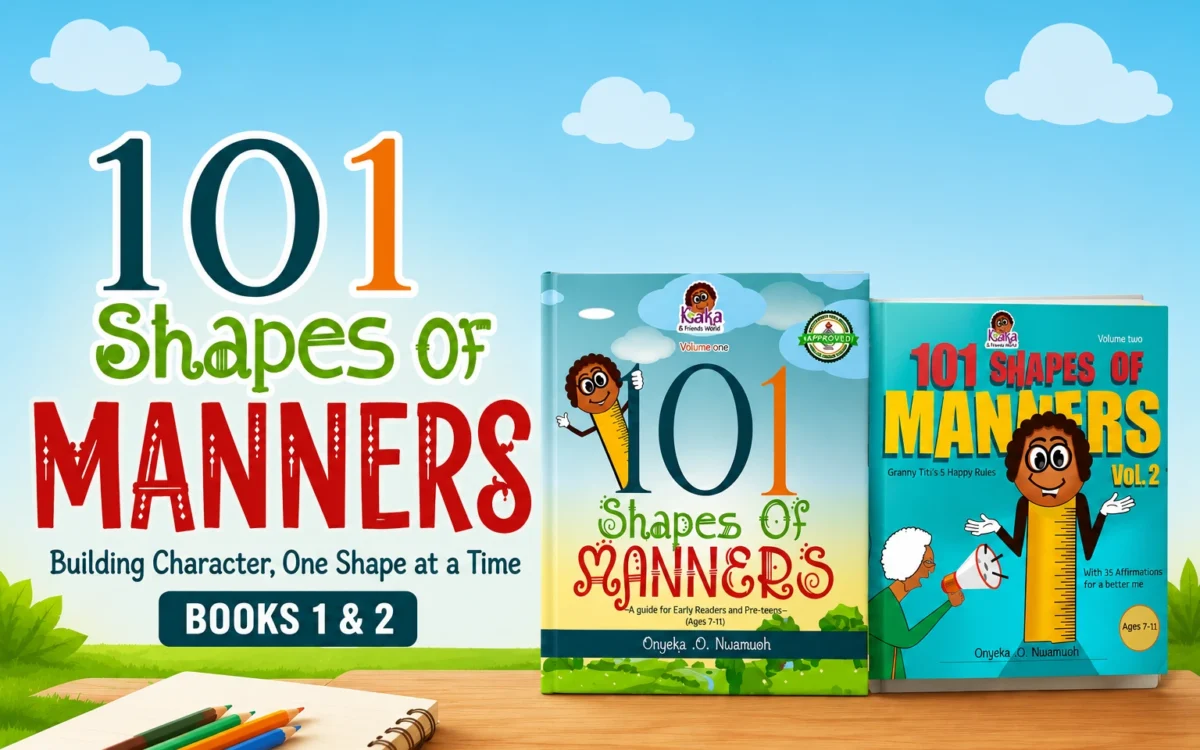
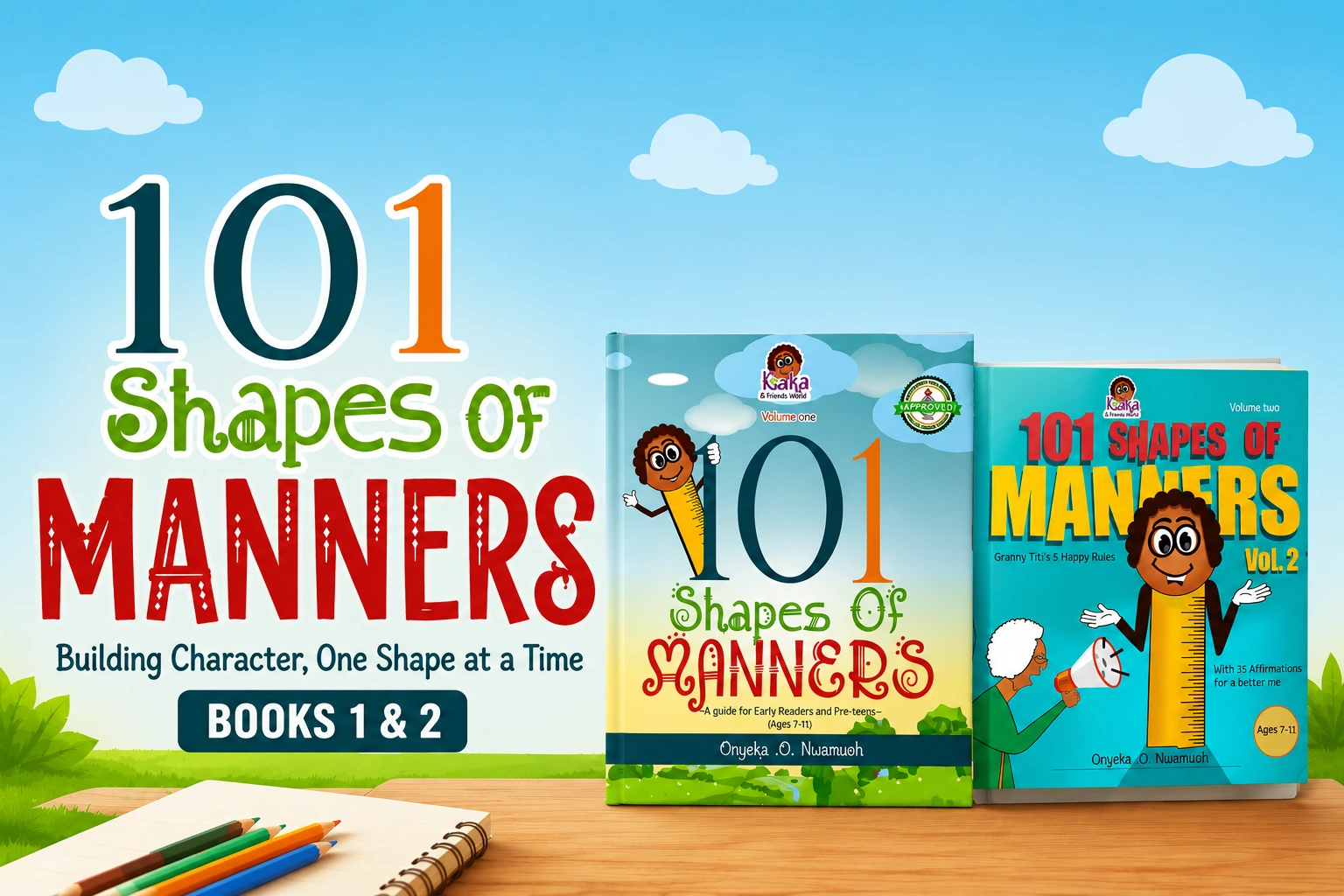
This is the core philosophy behind the 101 Shapes of Manners series – using illustrated characters to bring values like kindness, respect, empathy, and confidence to life. When looking at how to teach kids manners in a way that genuinely connects, seeing themselves in characters navigating real social situations helps the lessons become theirs, not yours.
“Children do not always remember every rule you give them. They remember every story you tell them.”
Strategy 4: Practise in Low-Stakes Situations
Do not wait for an important gathering to rehearse manners. Create low-pressure practice moments at home: pretend dinner parties, role-playing scenarios, practising greetings before calling a grandparent. Confidence with manners comes from repetition, not instruction.
Strategy 5: Praise the Character, Not Just the Behaviour
| ❌ Praises Compliance | ✅ Builds Identity |
| “Good, you said thank you.” | “I noticed how you thanked your teacher without being reminded. That shows real thoughtfulness.” |
| “Finally – you greeted them properly.” | “Did you see how their face changed when you looked them in the eye? That is what a confident, respectful person does.” |
| “You didn’t interrupt — well done!” | “You waited patiently for your turn even though you had something exciting to say. That takes real self-control.” |
Children who are consistently told they are kind, considerate, and respectful begin to act in alignment with that identity even when no one is watching. If you want to master how to teach kids manners, shifting from praising compliance to building identity is the ultimate secret. When children learn respect, they naturally build an inner sense of self-worth. If you want to dive deeper into this journey, read our complete guide on how to raise a confident child.
Strategy 6: Be Patient and Consistent
Learning manners is not a one-time lesson. It is a gradual, layered process requiring consistent reinforcement over months and years. Regression is normal, especially under stress, tiredness, or social pressure. What matters is the steady, patient return to expectation. Not every slip needs a lecture. Sometimes a quiet look is enough.
Key Takeaway: The six strategies that reliably work are: modelling the behaviour yourself, explaining the “why,” using stories and characters, practising in low-stakes moments, praising identity over compliance, and staying patient and consistent. None of them require nagging.
Common Mistakes Parents Make When Teaching Manners
- Forcing apologies that are not felt. A forced “sorry” teaches children to say the word without meaning it which is arguably worse than saying nothing. Work toward understanding first. The genuine apology will follow.
- Making manners feel like punishment. If your child associates “manners talk” with criticism and correction, they will resist. Positive attention for good behaviour should far outweigh corrections for poor behaviour.
- Being inconsistent. Children notice when rules apply selectively. If table manners matter at Grandma’s house but not at home on a Tuesday, the message received is that manners are performance, not values.
- Expecting too much too fast. Social skills develop progressively. An 8-year-old who occasionally forgets “please” is showing normal development, not a character flaw. Build your expectations around the child’s stage, not your anxiety.
Key Takeaway: The four most common mistakes are forcing insincere apologies, framing manners as punishment, applying rules inconsistently, and expecting too much too quickly. Avoiding these four dramatically improves how well children receive and retain what you teach.
How Manners, Confidence and Kindness Are Connected
It is worth stepping back to see the full picture. Manners, confidence, kindness, empathy and respect are not separate goals. They are deeply and directly interconnected.
- A child who knows how to greet people well feels more confident in new social situations
- A child who understands empathy naturally becomes kinder in their interactions
- A child who has been taught to listen is more respected by peers and adults
- A child who can handle disagreement respectfully becomes a leader, not a bully
Teaching manners is not about producing a performatively polite child. It is about raising a whole, confident, emotionally intelligent human being; one who treats others well because they genuinely understand why it matters.
Key Takeaway: Manners, confidence, kindness, empathy, and respect are not separate character goals, they are one interconnected system. Teaching manners well means raising a child who is not just polite, but genuinely good.
Quick Reference: Manners by Age Within 7–11
| Age | Developmental Stage | Key Manners Focus | Best Teaching Approach |
| 7–8 | Early logical thinking; rule-oriented | Greetings, please/thank you, not interrupting | Simple reasoning, role-play, immediate praise |
9–10 | Growing empathy; peer relationships intensify | Apologies, listening, kindness to friends | Story-based, peer scenarios, identity praise |
| 11 | Pre-adolescent; testing independence | Respectful disagreement, digital manners, tone | Dialogue, give autonomy, model consistently |
The Bottom Line
Understanding how to teach kids manners is one of the most valuable investments you can make in your child’s future. The window is real, the impact is lasting, and the strategies are straightforward, though they require consistency, patience, and your own willingness to model what you teach.
Start with one manner: build on it, tell stories, celebrate progress and correct with kindness.
You do not have to do this alone.
📖 Be the First to Discover 101 Shapes of Manners
The 101 Shapes of Manners is a brand-new illustrated social-emotional learning fiction series created specifically to help children ages 7–11 discover the values of kindness, respect, empathy, confidence, and good manners through relatable characters and stories they will genuinely love.
We are launching soon.
👉 [Join the Waitlist Now] — Get exclusive early access and be the first to know when we launch.
Frequently Asked Questions
At what age should children learn manners?
Children can begin learning basic manners from ages 2–3, but ages 7–11 is the most critical window for internalising why manners matter. At this stage, children are cognitively ready to understand empathy, cause and effect, and social expectations, enabling values to form, rather than just habits.
How do you teach a child manners without constant nagging?
The most effective methods are modelling the behaviour yourself, explaining the reasoning behind each manner rather than just giving instructions, using stories and characters to illustrate values, and praising your child’s character, not just their compliance. Consistent positive reinforcement significantly reduces the need for correction.
What are the most important manners for primary school-aged children?
The 10 most important manners for ages 7–11 are: proper greetings, genuine gratitude, real apologies, active listening, respectful tone, table etiquette, respecting others’ belongings and personal space, showing unprompted kindness, handling disagreement calmly, and appropriate screen use when with others.
.
Why does my child have good manners at school but not at home?
This is extremely common. Children typically show their most regulated behaviour in external settings because they feel safest being themselves at home. It is frustrating but it is actually a sign your child feels secure with you. The goal is gradual consistency over time, not identical behaviour in every setting immediately.
Do illustrated storybooks really help teach children manners?
Yes, and child development research supports this. Stories allow children to observe social situations from a safe emotional distance, process values through characters rather than direct instruction, and internalise lessons without feeling lectured or criticised. Books featuring relatable characters navigating real social challenges are among the most effective tools available to parents of 7–11 year olds.
101 Shapes of Manners is an upcoming illustrated storybook series for children ages 7–11. Join the waitlist to be the first to access the series when it launches.
What is the difference between teaching manners and teaching obedience?
Obedience is doing what you are told. Manners, at their best, are an expression of who you are. The goal of teaching manners to children ages 7–11 is not compliance, it is character formation. A child who says “please” because they fear consequences is obedient. A child who says “please” because they understand it shows respect for another person has genuinely good manners.
How long does it take to teach a child good manners?
There is no fixed timeline. Manners develop gradually across childhood and adolescence. Most parents find that consistent, patient reinforcement over three to six months produces noticeable, lasting change in specific areas. The key is focusing on one manner at a time rather than trying to address everything at once.