

Introduction
Learning how to raise a resilient child is one of the most urgent questions parents of school-age children are asking and one of the most misunderstood. Most parents picture a child who shrugs off setbacks, pushes through without complaint, never cries. This image is not only inaccurate, it is actively unhelpful. A child trained to suppress emotions is not resilient. They are brittle.
Resilience is not about raising children who are tough or unaffected. A resilient child might take a break, try a new strategy or revisit a challenge later. It’s not the absence of struggle rather it’s the capacity to move through struggle with support, skill and the growing belief that difficulty does not define you. And it is entirely teachable.
Table of Contents
TL;DR
Resilience in children is actually a learnable skill, rather than a fixed personality trait. The single most important factor is at least one stable, supportive adult relationship. The 9 strategies that most reliably build resilience in ages 7–11 include: allowing safe struggle, modelling healthy coping, building emotional vocabulary, teaching problem-solving, fostering connection, praising effort not outcome, creating routine and predictability, using stories and making help-seeking safe. Ages 7–11 is the most critical window; when resilience patterns become established and children are most responsive to deliberate support.
How to Raise a Resilient Child: What Resilience Actually Is
Before figuring out how to raise a resilient child, it helps to understand precisely what you are building because most popular definitions miss the mark.
Resilience is a product of learned skills and opportunities, not exactly inborn character. It is built through specific experiences, relationships and conditions that parents have significant influence over.
Children who are supported through discomfort are more likely to develop confidence and autonomy, and a stronger sense of self-worth when parents focus on effort, problem-solving, and character.
Resilience at ages 7–11 looks like: trying again after failing a test, returning to a friendship after a falling-out, moving through sadness or frustration rather than being defined by it, and asking for help when something is too hard alone. Resilience shouldn’t and doesn’t look like never crying, pretending not to care or suppressing feelings to appear strong. Understanding this distinction changes everything about how we parent for resilience.
Key Takeaway: Resilience is the learned capacity to move through difficulty with skill and support. A child who can feel hard things, process them and keep going is far more resilient than one taught to pretend nothing is hard.
How To Raise A Resilient Child: Why Ages 7-11 Is The Critical Window
Not all childhood stages are equally important for resilience development. Ages 7–11 stands out for three specific reasons.
Resilience patterns are being established. The emotional coping habits formed between 7 and 11 years such as, suppressing, exploding, withdrawing or working through become the default patterns carried into adolescence and adulthood. Teaching kids to name, tolerate and move through difficult emotions is a critical component of resilience at this stage.
The social world is significantly more complex. At this age, children navigate friendship dynamics, academic pressure, social hierarchies and the first significant experiences of failure and exclusion. Each is a natural resilience-building opportunity if children have the tools to process it.
The brain is highly responsive to support. Stress during childhood can cause changes in the brain but environmental factors powerfully promote resilience. Both internal factors like self-control and external factors like supportive relationships contribute to a child’s ability to flourish and bounce back. The parent’s role during these years is genuinely significant.
What the research shows:
| Finding | Source |
The single most common factor among children who develop resilience is at least one stable, committed relationship with a supportive adult | Harvard Center on the Developing Child, cited in Big Life Journal |
Resilience is a product of learned skills and opportunities, not inborn character | Psychology Today, November 2024 |
| Children who are supported through discomfort develop greater confidence and autonomy and a stronger sense of self-worth | Psychology Today, April 2026 |
| Providing children with a sense of safety, feeling seen, being soothed, and feeling secure are the foundational predictors of resilience | Dr. Tina Payne Bryson, Thrive Center, January 2025 |
| Resilience grows through everyday practices, rather than just big life lessons; naming emotions, practising calming strategies and building strong conversations are key | Begin Learning / Dr. Erin Brickley, Pediatrician, September 2025 |
Key Takeaway: Ages 7–11 is when resilience patterns are established, the social world becomes genuinely challenging, and the brain is most responsive to parental support. The work done here shapes how a child faces difficulty for the rest of their life.
The Single Most Important Factor in Building Children’s Resilience
Before diving into strategies and techniques on how to raise a resilient child, there is one foundational finding that every parent needs to know.
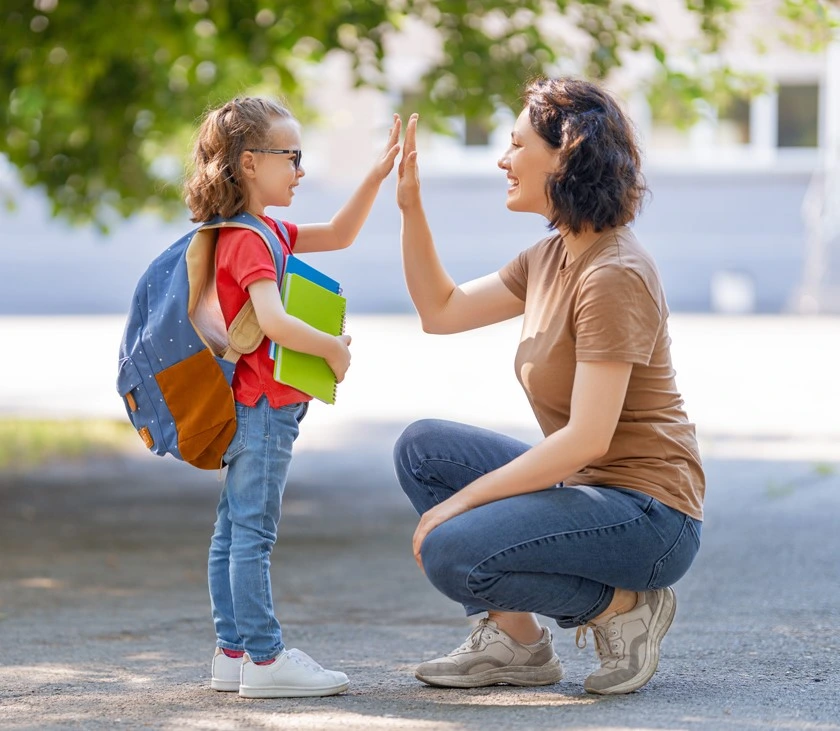
According to the Harvard Center on the Developing Child, the “single most common factor” for children who develop resilience is at least one stable, committed relationship with a supportive adult role model.
This goes beyond a curriculum, a set of exercises, a book or a programme, the main factor is just one stable, committed, supportive adult. It’s that simple
You, the parent reading this, are already the most important resilience resource your child needs. Your consistent presence, your warmth under pressure, your willingness to sit with difficult feelings without fixing them: these are the conditions research identifies as the most powerful predictors of resilience.
Children just need us to be present; in unimpressive, day-to-day opportunities, not infrequent grand gestures. And most reassuringly: you are probably already doing better than you think.
9 Strategies That Actually Build Resilience in Children Ages 7–11
1. Allow Safe Struggle, Stop Rescuing Immediately
When we immediately step in to fix a problematic situation, we send the message that discomfort is intolerable. When we pause and support instead, we teach children that they are capable.
This is the hardest strategy for most parents to implement and the most important. Every time you solve a problem your child could have solved themselves, you take away a small piece of evidence that they are capable. Over time, the accumulated message is: you cannot handle this without me.
How to apply it: When your child struggles, wait a few seconds before intervening. Ask “what do you think you could try?” before offering solutions. When they fail, respond with curiosity: “That didn’t work. What did you learn? What could you try differently?”
2. Model Healthy Coping Visibly
Children often learn how to deal with stress from observing their parents. As you navigate stress in your life, practise healthy coping: exercise, breathing exercises, connecting with friends or family for support.
The coping strategies your child reaches for in difficulty are the ones they have seen you use. If you suppress and push through, they will. If you name your feelings and regulate yourself, they will too.
How to apply it: Narrate your coping out loud: “I’m feeling stressed. I’m going to take five slow breaths before I respond.” Let your child see that difficulty is normal and manageable.
3. Name Emotions, Build the Vocabulary First
Naming feelings – “you’re really frustrated right now” helps children feel understood without dismissing their experience. Children don’t need their feelings fixed right away. They need to learn that emotions are temporary and manageable.
A child who cannot name what they feel cannot begin to regulate it.
How to apply it: Name emotions you observe: “You seem really disappointed.” Introduce one new emotion word per week, for instance; conflicted, overwhelmed, apprehensive, deflated. Use emotion language naturally in stories and everyday conversation.
4. Teach Problem-Solving, Do Not Just Solve
Resilience is about building confidence and tools, then using them to move through stress. Return to Routine, Regulate, Reassure: predictability provides safety, regulation equips children to face challenges, and reassurance communicates they are not alone.
How to apply it: Work through problems with your child rather than solving them. Try: “What is the problem? What are three things you could try? Which feels right?” This builds the problem-solving muscle resilience draws on.
5. Build Strong, Stable Relationships
Having a good parent-child relationship is one of the best ways to raise resilient children and supporting other strong, positive adult relationships amplifies this further. A child with multiple stable adult relationships has a significantly wider safety net than one whose only strong adult bond is with their parents.
How to apply it: Invest in your relationship in small, daily moments rather than just big ones. Actively foster your child’s relationships with other trusted adults. The more safe people in a child’s life, the wider their resilience net.
6. Praise Effort and Character, Not Only Outcome
The connection between effort-based praise and resilience is one of the most well-established findings in child development research. When children are praised for being clever or talented, they avoid challenges that might disprove the label. When they are praised for effort, persistence, and character, they seek challenges as opportunities to grow.
How to apply it: After a hard task whether they succeeded or not, focus on process: “You stayed with that even when it was really hard. That kind of persistence is exactly what gets you further.” After failure: “That didn’t go the way you hoped. What did you do that was worth being proud of, even so?”
7. Create Routine and Predictability
Return to Routine: predictability provides kids with a sense of safety. Children who know what to expect such as; consistent mealtimes, bedtimes, family rituals and predictable responses from caregivers feel secure enough to take the risks that build resilience. Uncertainty and unpredictability create anxiety. Stability creates the foundation from which brave attempts become possible.
How to apply it: Establish daily rhythms not as rigidity, but as anchors. When disruption happens, return to routine as soon as possible. The return itself is a resilience message: we can weather disruption.
8. Use Stories to Build Resilience Templates
Stories allow children to experience adversity and recovery at a safe emotional distance, building what psychologists call a resilience template: an internal narrative about how difficulty works and how people move through it.
This is the vision at the heart of the 101 Shapes of Manners series, illustrated characters for ages 7–11 who navigate real challenges with courage and emotional honesty, helping children see themselves as capable of the same.
“A child who has read about a character getting back up after falling has already practised, in the safest possible way, what getting back up feels like.”
9. Make Help-Seeking Safe and Normal
Despite our image of resilient people pulling themselves up by their bootstraps, the research shows the opposite: resilient people are not shy about asking for help. By feeling comfortable asking for help, a child avoids internalising problems, solves them more easily, and builds stronger relationships in the process.
A child who has been taught that asking for help is weakness will face difficulty alone. A child who knows that asking for help is a skill, one that resilient people practise readily, will face difficulty with support.
How to apply it: Ask for help visibly yourself: “I’m going to talk to someone I trust about this.” Respond warmly every time your child comes to you. Never make them feel foolish. The message: coming to someone when things are hard is strength, not weakness.
Key Takeaway: The 9 strategies are: safe struggle, modelling healthy coping, naming emotions, teaching problem-solving, building strong relationships, praising effort, creating routine, using stories and making help-seeking safe. Together they build the internal and external resources children draw on when difficulty hits.
The Things Parents Do That Quietly Undermine Resilience
Most resilience-undermining behaviours come from love. Therefore, they are worth naming precisely because of that.
Rescuing too quickly. Every problem solved before the child has tried removes evidence that they are capable. Repeated across childhood, this produces a child who does not trust their own ability to handle difficulty.
Dismissing difficult feelings. “You’re fine. Just move on.” When a child’s emotional experience is minimised, they learn feelings are to be pushed through, not processed. This is the opposite of resilience.
Overprotecting from failure. Failure is not the enemy of resilience rather it’s the raw material of it. A child who has never had to pick themselves up has no evidence that they can.
Modelling poor coping. A parent who visibly cannot tolerate frustration or avoids difficulty teaches those patterns. The most powerful resilience teaching is not what you say, it is what you do when things are hard.
A note on professional support: If your child is experiencing persistent anxiety, significant withdrawal, or difficulty bouncing back from normal challenges over several months, consider speaking with their school counsellor or a child psychologist. Resilience-building strategies support healthy development but they are not a substitute for professional support when a child is genuinely struggling.
How Resilience Connects to Confidence, Manners and Values
Resilience and confidence share the same foundation: mastery experiences that prove a child is more capable than they thought. Resilience and manners reinforce each other: a child who handles disagreement respectfully and repairs a friendship after conflict is practising resilience in social form. And resilience and values are inseparable: a child whose identity is rooted in knowing they are kind and honest has something stable to return to when difficulty hits.
This is why the 101 Shapes of Manners series addresses resilience alongside confidence, manners and values not as separate goals, but as one integrated picture of a child equipped to handle what life brings.
The Bottom Line
Raising a resilient child does not require perfection. It requires presence, the willingness to let your child face difficulty and be there when they do. Not to remove it, but to help them discover they can move through it.
Children just need us to be present in day-to-day opportunities, not necessarily in big gestures. You are probably already doing better than you think.
Start with one strategy and stay consistent. Your child is building something through every hard moment they face. Your job is to make sure they do not face those moments alone.
📖 Be the First to Discover 101 Shapes of Manners
The 101 Shapes of Manners is a brand-new illustrated social-emotional learning fiction series for children ages 7–11 designed to help build resilience, confidence, kindness and good character through stories children genuinely love.
Because a child who has practised being brave inside a story is already more ready to be brave outside one.
👉 [Join the Waitlist Now] — Get exclusive early access and be the first to know when we launch.
Frequently Asked Questions
What is resilience in children and why does it matter?
Resilience is the learned capacity to face difficulty and move through it rather than being defined by it. Research confirms it is a product of learned skills and supportive relationships, not inborn character. It matters because difficulty is inevitable, and a child with resilience tools faces challenges with confidence rather than collapse.
What is the single most important factor in building resilience in children?
According to the Harvard Center on the Developing Child, the single most common factor among children who develop resilience is at least one stable, committed relationship with a supportive adult, not a programme or technique. The most important resilience resource your child has is your consistent, warm presence.
How do I build resilience in my child without being too hard on them?
The goal is not to make things harder, it’s to stay present when they are. Allow age-appropriate struggles without immediately rescuing. Name feelings without dismissing them. Praise effort over results. Model healthy coping. These build resilience through presence and support rather than through withholding warmth.
Does praising effort really build resilience?
Yes, when praised for outcomes and talent, children avoid challenges that might disprove the label. When praised for effort and character, they seek challenges as growth opportunities. A child who believes ability is developed rather than fixed is significantly more resilient, because failure becomes information, not verdict.
Can stories and books help build resilience in children?
Yes, stories allow children to experience adversity and recovery at a safe emotional distance, building a resilience template. A child who has read about a character who faces failure and keeps going has already practised that emotional arc in the safest way possible. Illustrated books with relatable characters are among the most effective resilience-building tools for ages 7–11.
How is resilience different from toughness?
Toughness means suppressing difficulty: pushing through without processing distress. Resilience means moving through difficulty with skill, support and emotional honesty. Toughness avoids hard feelings. Resilience processes them. Research consistently shows children taught to process emotions develop significantly stronger long-term coping than those taught to suppress.
101 Shapes of Manners is an upcoming illustrated social-emotional learning fiction series for children ages 7–11. Join the waitlist to be the first to access the series when it launches.