Introduction
Why do illustrated books teach children morals better than lectures? Most parents reach instinctively for words when they want to teach something important, a conversation about kindness, a talk about honesty, an explanation of why respect matters.
These conversations aren’t entirely unhelpful, but the research on how children actually internalise values tells a consistently different story.
The most effective vehicle for moral education has never been the lecture rather it has been the story. What developmental psychology, cognitive neuroscience and educational research have spent two decades proving is that this instinct was right, and that the mechanism behind it is far more powerful than most parents realise.
This post explains how illustrated books build moral character in children ages 7–11, why stories work where lectures fail, and how to use books at home to raise a child who does not just know what is right but feels compelled to do it.
Table of Contents
TL;DR
Illustrated books teach children morals more effectively than lectures because of a well-documented psychological process called narrative transportation; the mental and emotional journey a reader takes when they become absorbed in a story. This process builds empathy, moral reasoning and prosocial behaviour in ways that direct instruction cannot replicate. For children ages 7–11, illustrated books are particularly powerful because visual storytelling activates both hemispheres of the brain, and characters who look and feel real create deeper identification than abstract principles ever could.
The Lecture Problem – Why Telling Children What Is Right Rarely Works
Most parents have experienced a version of this. You explain carefully why honesty is the way to, why kindness is important, why respect is non-negotiable. Your child listens, nods and within the hour does the exact thing you just addressed.
This is not a failure of parenting. It is a feature of how minds process moral information. Direct instruction activates analytical processing: the child evaluates the information, files it, and then, moves on. What it does not produce is the emotional experience that makes a value feel personally important; that sense of ‘this matters to me because I have experienced why it does’.
Research identifies three routes through which stories build moral character: acquiring new moral insights, practising social-cognitive skills through perspective-taking, and engaging in discussion of complex moral dilemmas. All three happen naturally during story reading. None happen as readily during a lecture, which is why understanding the deeper balance between digital media and reading is so vital as explored in our guide on Screen Time vs Reading for Children: Best Balance
Key Takeaway: Lectures activate analytical processing: children file the information and move on. Stories activate emotional and moral processing – children experience the value from the inside. That felt experience is what transforms a rule into a character trait.
The Science Behind Why Stories Work
The psychological mechanism through which stories build moral character has a name: narrative transportation.
Narrative transportation is the process by which a reader becomes absorbed in a story, experiencing the character’s emotions and dilemmas, and emerging with those experiences having shaped their beliefs and values.
Research proposes “dual empathy”, readers simultaneously feel empathy for the character and for themselves, because the narrative triggers autobiographical memories and thoughts. This is what makes stories powerful for moral development. When a child reads about a character facing a real choice whether to be honest when it costs something, or to include the child everyone else is excluding, they are not observing from a distance. They are living it.
Over 15 years of empirical evidence demonstrates that narrative fiction effectively stimulates theory of mind and empathy in young and adult readers. Theory of mind: understanding that others have their own thoughts and perspectives, is the cognitive foundation of empathy and moral behaviour. Stories build it through every character whose inner world the reader inhabits..
What the research shows:
| Finding | Source |
Narrative fiction effectively stimulates theory of mind and empathy in both young and adult readers – a finding consistent across 15 years of empirical research | Mar et al., 2010; van der Kleij et al., 2025; Wimmer et al., 2024 – Oxford Academic, 2026 |
Shared book reading with guided discussion helps children identify story characters’ emotions, recognize their own emotions, differentiate their feelings from others’, regulate their emotions and develop empathy across a variety of scenarios | Frontiers in Psychology, August 2025 |
| Stories in narrative format have a positive effect on empathic attitudes, and this effect generalizes to real-world groups, not just fictional characters | Batson et al., 1997, 2002; Oliver et al., 2012 – ScienceDirect |
| Beautiful and realistic characters lead to higher reader involvement, a combination of empathy and identification that is the key mechanism of moral learning through story | Konijn and Hoorn, 2005 – Narrative Transportation research |
Key Takeaway: Narrative transportation is the psychological mechanism through which stories build moral character. When children are absorbed in a story, they experience the character’s moral dilemmas from the inside, producing the emotional understanding that lectures cannot manufacture and that makes values personally meaningful.
Why Illustrated Books Work Especially Well for Ages 7–11
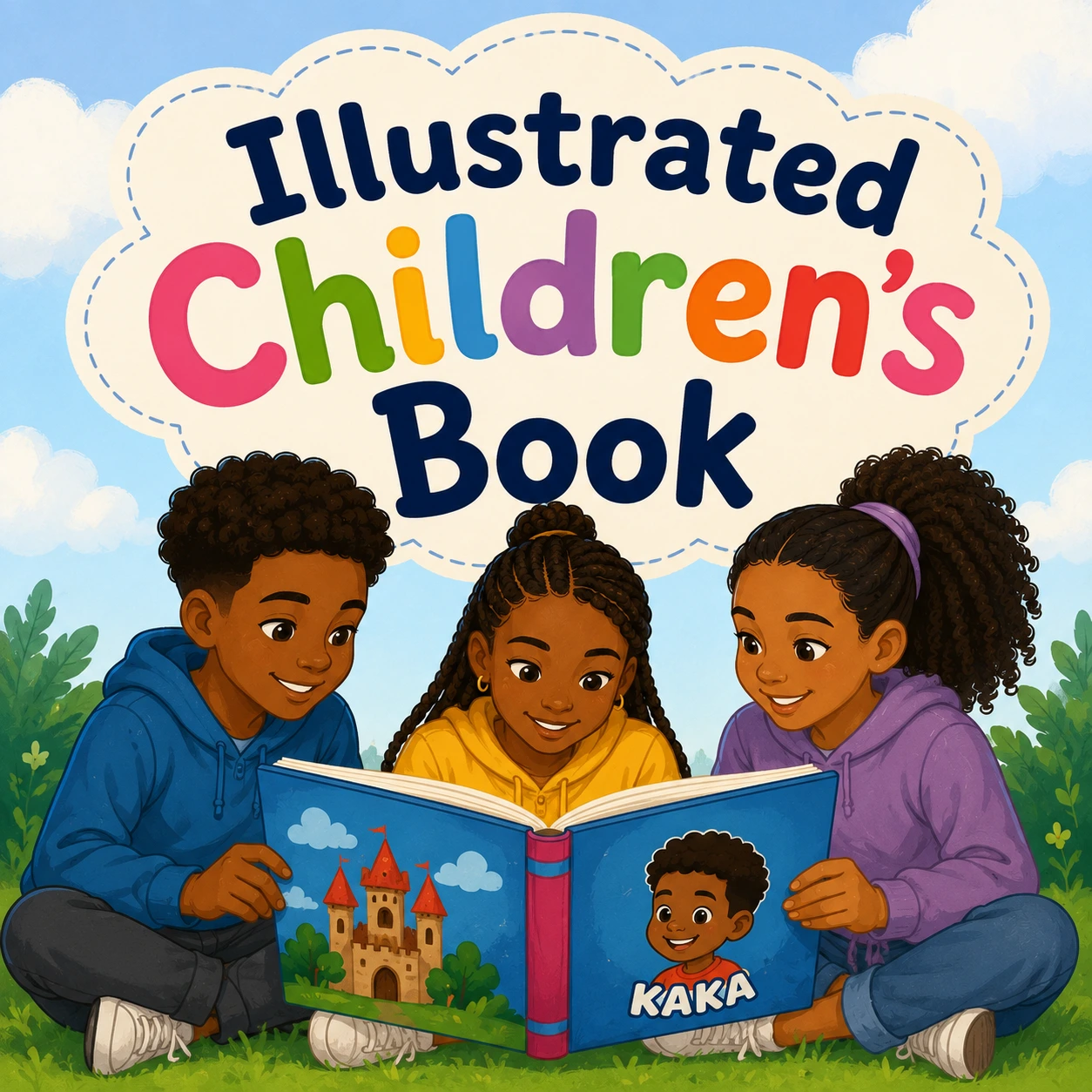
Not all storytelling formats are equally powerful for this age group. Illustrated books, where text and visual imagery work together to create character and world, have specific advantages for children between the ages of 7 and 11.
Visual storytelling activates both hemispheres of the brain. Text alone engages primarily the left hemisphere – language, logic, sequential processing. Illustrations engage the right – emotional processing and imaginative construction. When both work together, emotional engagement is deeper and memory of the experience significantly stronger.
Characters become people, not concepts. In an illustrated book, a character has a face and an expression, present and specific in a way that a described character alone is not. Beautiful and realistic characters lead to higher involvement, a mix of empathy and identification. A child who sees the hurt on a character’s face when excluded does not need to be told that exclusion is unkind. They feel it.
The pacing allows emotional processing. Illustrated books move at the reader’s pace, a child can pause on a page, take time with an image, return to a moment. This creates space for emotional processing that faster-moving media does not.
They create a shared language for families. A book read together becomes a reference point both parent and child can return to. “Remember how Kaka felt when nobody listened? That is what is happening right now.” This transfer from story to life is how moral lessons become moral habits.
Key Takeaway: Illustrated books engage both hemispheres of the brain simultaneously, make characters feel real enough to identify with, allow emotional processing at the reader’s own pace and create shared family reference points that transfer moral lessons into everyday life.
What Children Are Actually Learning When They Read
When a child between ages 7–11 reads an illustrated storybook featuring a character who navigates a real moral challenge, they are not passively consuming entertainment. They are actively building a set of capacities that no classroom lesson or parental lecture can produce as efficiently.
Theory of mind and perspective-taking. Every time a child inhabits a character’s inner world, they practise understanding that others have their own thoughts and feelings. Through guided discussion, children progressively learn to identify characters’ emotions, recognise their own, differentiate their feelings from others’, regulate their emotions, and develop empathy across a variety of scenarios forming the core foundation of How to Teach Kids Empathy.
Moral reasoning. Stories present moral dilemmas not as abstract principles but as lived situations to be felt. Children who encounter moral complexity through stories develop significantly stronger moral reasoning than those who only receive direct instruction.
Emotional vocabulary. Stories give children words for emotions they have not yet encountered. A child who has read about humiliation, moral courage, or the conflict between loyalty and honesty has a richer emotional vocabulary than one who has only been told that feelings matter.
Identity formation. Most powerfully: narrative transportation triggers autobiographical memories and thoughts, readers simultaneously feel empathy for the character and for themselves. A child who identifies with a character who chooses kindness or speaks up for someone treated unfairly begins to see themselves as that kind of person. The story becomes part of their identity, not just their memory.
Key Takeaway: Through illustrated books, children build theory of mind, moral reasoning, emotional vocabulary, and most powerfully, an identity as a person of good character. These are not byproducts of reading. They are what reading morally rich stories is specifically designed to produce.
How to Use Illustrated Books to Teach Morals at Home
Reading is only the beginning. The research is consistent: moral learning from story is significantly deepened by the conversations around it.
Step 1: Choose Books With Real Moral Complexity
Avoid books where the moral is stated explicitly at the end. The most effective books present a genuine dilemma, allow the reader to feel the stakes, and show rather than explain the consequences of different choices. Look for characters who face real challenges and endings that reward reflection rather than close it down.
2. Read Together, Not Just Aloud
Shared book reading with conversation about emotions provides a powerful tool for fostering children’s emotional competence. Training in this practice helps children progressively identify the emotions of story characters, recognise their own emotions and develop empathy across a variety of scenarios.
Reading together activates the full moral learning potential of the book. Your presence and willingness to pause signal that this story matters.
How to apply it: Pause at moments of moral tension and share your own response first: “I found it hard to watch that character stay silent. What did you think?”
3. Connect the Story to Real Life, Gently
The most important thing after a morally rich story is asking questions that invite genuine reflection, not ones that lead to the right answer.
Avoid: “So we learned that being kind is important, right?”
Use: “Why do you think the character made that choice? Was it the right one? What would you have done?”
Leading questions close down thinking. Open questions activate the moral reasoning the story has primed.
4. Connect the Story to Real Life, Gently
The transfer from story to life is where moral learning becomes moral habit and it works best when gentle and specific.
How to apply it: When a real situation mirrors a recent book, reference it naturally: “This feels a bit like what happened to that character. What do you think they would do?” The child’s own connection to the character is more persuasive than any instruction.
5. Let the Child Disagree With the Book
When a child says “I don’t think that character did the right thing”, that is moral reasoning in action. Do not shut it down, engage with it.
How to apply it: “That’s interesting, tell me why. What would you have done instead?” A child who has practised arguing about a fictional character’s moral choices is a child who can think independently and ethically about their own.
Key Takeaway: The full moral learning potential of illustrated books is unlocked not just by reading, but by the conversations around reading, asking open questions, connecting story to life and welcoming disagreement as moral reasoning in action.
What to Look for in a Morally Rich Children’s Book
Not all illustrated books are equally effective for moral development. These are the hallmarks of a book that genuinely builds character.
Characters with genuine interiority. The most powerful books give readers access to what a character thinks and feels, not just what they do. A child needs to inhabit a character’s inner experience to develop empathy through them.
Moral dilemmas without easy answers. Books where the right choice is obvious from the first page confirm moral reasoning, they do not build it. Look for books where the character genuinely struggles and the resolution feels earned.
Characters who look like your child. Identification is a key mechanism of moral learning through story. A child who sees themselves in a character – their appearance, their world, their challenges, identifies more deeply and internalises the character’s choices more readily.
Illustrations that carry emotional weight. In the best illustrated books, the pictures do moral work that text alone cannot. A character’s expression and posture communicate things no sentence can fully replicate.
This is the vision at the heart of the 101 Shapes of Manners series, illustrated stories for children ages 7–11 built around characters navigating real challenges: kindness, confidence, respect, empathy and the courage to do the right thing when it is hard. Not rules to memorise but stories to live inside.
“A child who has felt what it is like to be the person who shows kindness will find it far easier to become that person. That is what stories do that nothing else can.”
The Bottom Line
The reason illustrated books teach children morals better than lectures is not sentimental, it is scientific. Stories activate the psychological processes through which moral character is built: narrative transportation, perspective-taking, emotional processing, and identity formation. Lectures activate none of them with the same depth.
This does not make parental conversations worthless though, they are essential as the discussions that extend what stories begin. But the story comes first and the felt experience also as well as the lesson that lives in a child’s body, not just their memory..
Give your child stories that challenge them, characters they can see themselves in, and space to reflect. That is the oldest and most effective form of moral education in human history.
📖 Be the First to Discover 101 Shapes of Manners
The 101 Shapes of Manners is a brand-new illustrated social-emotional learning fiction series for children ages 7–11, built on exactly the principles this post describes. Real characters, real dilemmas, real moral stakes. And the kind of storytelling that makes values feel worth having.
👉 [Join the Waitlist Now] — Get exclusive early access and be the first to know when we launch.
Frequently Asked Questions
Why do stories teach children moral lessons better than direct instruction?
Stories teach morals more effectively because of narrative transportation – the state in which a reader becomes absorbed and experiences the character’s emotions from the inside. A child told that kindness matters files the information. A child who has felt what it is like to be the character who chooses kindness internalises that experience as identity.
What is narrative transportation and how does it affect children?
Narrative transportation is the process by which a reader becomes absorbed in a story and experiences the characters’ dilemmas as their own. Fifteen years of research confirms it stimulates theory of mind and empathy in young readers, producing real changes in moral beliefs and prosocial behaviour. For children between ages 7–11, at a critical stage of empathy and identity development, the effect is particularly significant.
Are illustrated books better than chapter books for teaching values?
Both have value, but illustrated books have specific advantages for ages 7–11. Visual storytelling activates both hemispheres simultaneously. Illustrations make characters feel real, deepening identification. And the natural pause: turning a page, sitting with an image, allows emotional processing at the child’s own pace. Research shows realistic and visually engaging characters produce the highest reader involvement, which is the key mechanism of moral learning.
How should I use books to teach my child values at home?
Read together rather than sending your child to read alone. Ask open questions – “why do you think the character made that choice?” not “so we learnt that being kind is important, right?” Connect the story to real situations when they arise naturally. Welcome disagreement with a character’s choices, that is moral reasoning in action.
What makes a children’s book good for moral development?
Morally rich books have: characters with genuine inner lives, dilemmas without easy answers, specific and emotionally real consequences, characters who look like the child reading, and illustrations that carry emotional weight. Books where the lesson is stated explicitly at the end are far less effective than ones that present moral complexity and trust the reader to engage with it.
Can books replace conversations about values with my child?
No. The most powerful combination is books and conversation together. Stories prime children for moral reflection; discussion activates it and transfers it to real life. A parent who reads with their child, asks open questions, and connects story to situation produces moral learning deeper than either tool could produce alone.
101 Shapes of Manners is an upcoming illustrated social-emotional learning fiction series for children ages 7–11. Join the waitlist to be the first to access the series when it launches.